Loading...
Please wait while we load the content...

Loading...
Please wait while we load the content...
Loading...
Please wait while we load the content...
Explore peer - reviewed titles across the humanities and social sciences - rigorous research, fresh perspectives, and scholarship that inspires dialogue across disciplines.
Stay informed about our latest publications, calls for proposals, author news, events, and special announcements.
Join our community of scholars, librarians, authors, and readers and receive the latest updates from Vernon Press directly in your inbox.
From special discounts and global distribution partners to downloadable catalogs, flyers, and high-resolution covers, we make it easy to enrich your library’s collection. Access bibliographic data, explore subject-specific listings, and stay updated on forthcoming titles.
Become part of our librarian network and access dedicated tools, discounts, and resources to support collection development and promote new titles to your patrons.
Partner with Vernon Press to provide your customers with high-quality, peer-reviewed scholarship. We offer flexible ordering options, reseller agreements, and promotional materials to support your sales and outreach.

Vernon Press provides dedicated resources to help instructors adopt our books for courses and to support students with affordable access to high-quality scholarship. From desk and examination copies to tailored student editions, we aim to make our titles accessible in the classroom.
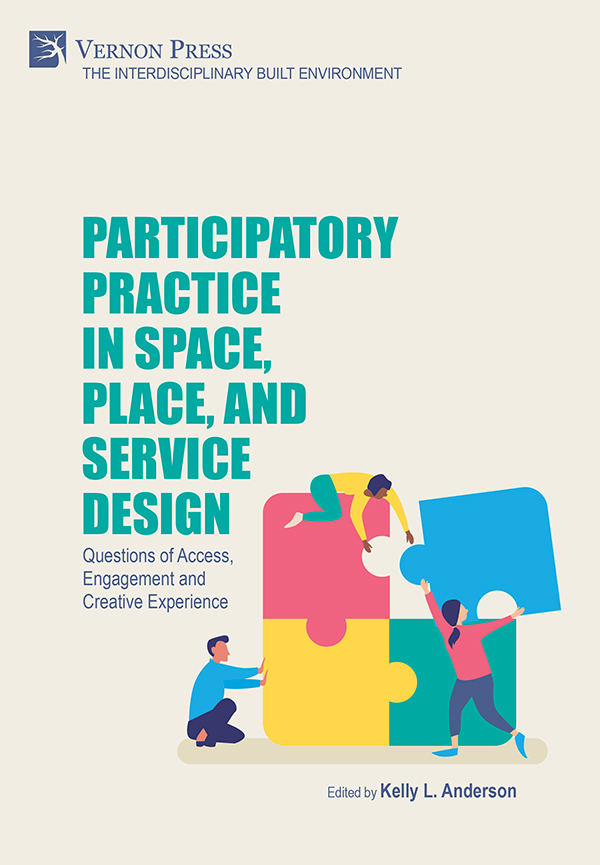
Questions of Access, Engagement and Creative Experience
Edited by: Kelly L. Anderson (Monash University)
'Participatory Practice in Space, Place, and Service Design' is premised on a belief in the importance of participatory practices in finding creative solutions to the plethora of problems we face today. It argues that engaging professions with the public in mutual exploration, analysis, and creative thinking is essential. It not only ensures better quality products, places, services, and a greater sense of civic agency but also facilitates fuller access to them and the life opportunities they can unleash. This book offers a uniquely varied perspective of the myriad ways in which participatory practices operate across disciplines and how they impact the worlds and communities we create and inhabit. This book suggests that participatory practices are multi-disciplinary and relevant in fields as diverse as design, architecture, education, health care, sustainability, and community activism, to name a few of those discussed here. How do designed objects and environments affect wellness, creativity, learning, and a sense of belonging? How do products and services affect everyday experience and attitudes towards issues such as sustainability? How does giving people a creative voice in their own education, services, and built environments open up their potential and strengthen identity and civic agency? Addressing these questions requires a rethinking of relations between people, objects, and environments; it demands attention to space, place, and services.
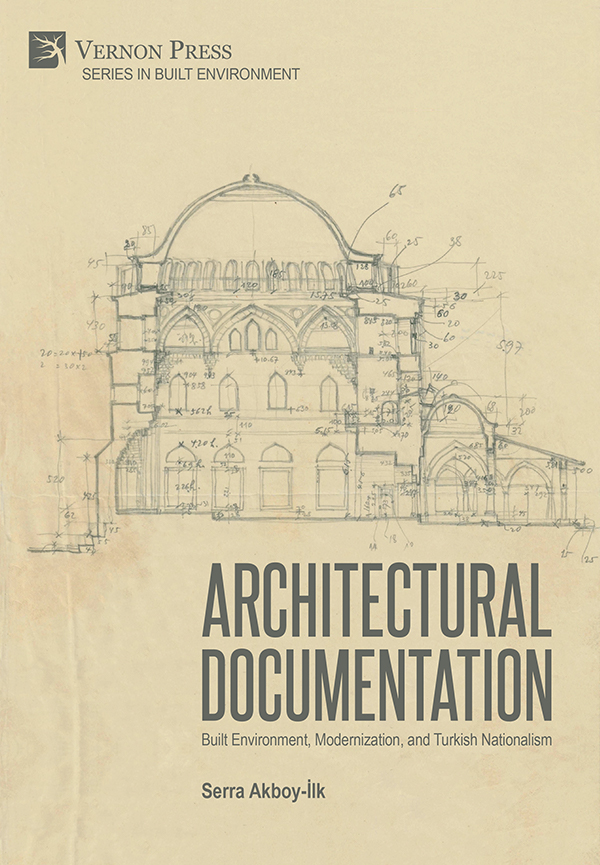
By: Serra Akboy-Ilk (Collin College)
Against the backdrop of building a new country, this study explores and evaluates the documentation culture in early republican Turkey. Having fought the Turkish War of Independence (1919–22) against the Allied Powers, the revolutionaries led by legendary leader Mustafa Kemal Atatürk (1881-1938) came to engage with the idea of the West and its cultural origin. With the proclamation of the Republic of Turkey in 1923, the constitution abolished the 600-year-old Ottoman Empire including the dynastic cultural, economic, educational, and governmental institutions. In the redemption of the nation within the modern history of civilizations, cultural Westernization and technical modernization became the model for the newly found nation-state. While the new country became the subject of reformation, historic architecture was called upon to grant the aura of a glorious past to the Turks. Through the materialization of ‘Türk Tarih Tezi’ (the Turkish History Thesis), the founding leaders focused on the origin of Turks and the everlasting spirit of the Turkish state. In this pursuit, architectural heritage signified the formative power to represent the past. Supported by state-agencies, scholars, with supreme patriotic zeal and diligence, travelled across the remotest corners of the country to document and study the historic architecture of the nation. To date, the complicated question of a national identity embodied in the built environment has dominated the contemporary scholarship on early republican historiography. Akboy-İlk’s study, however, distinguishes itself with its focus on architectural documentation, which became an agent of history-writing in the early years of the nation state. Curated by the ideologies of the state, the formal documentation findings extensively informed the republican plot of the modern progress of Turks. For scholars interested in a closer reading of the crossing boundaries between architectural heritage and nation-building in the case of the modernization of Turkey, this book is revealing and provocative in bringing forward architectural documentation, a remarkably overlooked subject in studies of the area.
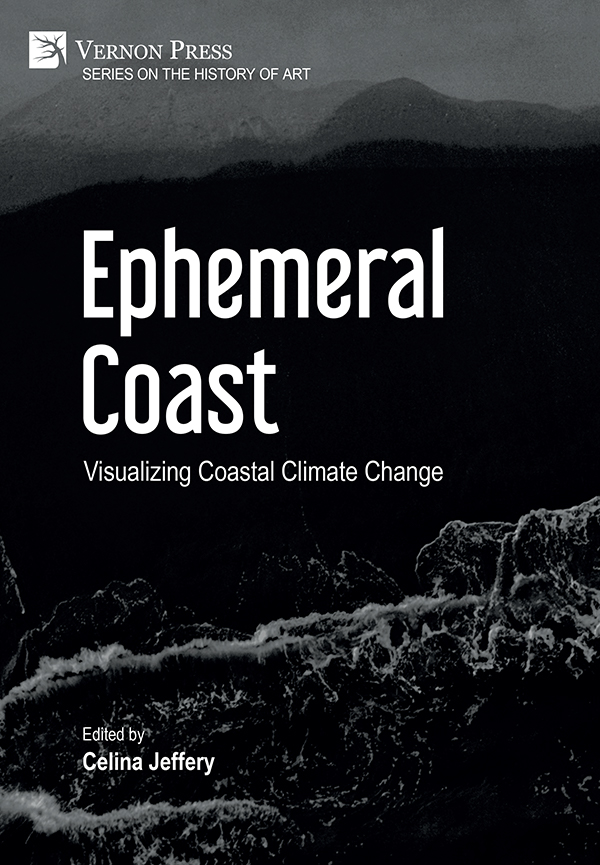
Edited by: Celina Jeffery (University of Ottawa)
'Ephemeral Coast: Visualizing Coastal Climate Change' considers the ways that art can offer a means through which to discover, analyze, re-imagine and re-frame emotive discourses about the ecological and cultural transformations of the coastline. This edited anthology takes ephemerality as its central conceptual and methodological framework and presents a series of essays that create interconnections between environmental and social considerations of the coast, a succession of embodied creative practices, and shifting regional geographic identities. The book presents a series of specific case studies of artistic practices and strategies that seek to capture the rewriting of cartographic maps that are being reshaped by rising seas, coastal flooding and catastrophic weather. The essays in this edited volume engender creative strategies for understanding new and uncertain coastal ecologies and the loss, expulsion or destruction of their associated cultures, habitats, species and ecosystems. The anthology also looks at the historical, mnemonic and contemporary transitional conditions of ‘conflicted’ coastal spaces in which empire, modernity and globalization press on coastal erosion and incursions, proliferate it with trivial plastics, pollution and disposable attitudes, and bring vulnerable communities into uncertain futures.
Edited by: Raymond M. Klein (Nova Scotia College of Art and Design University)
The Drawing Laboratory at NSCAD University was founded with funding from the Social Sciences and Humanities Research Council of Canada in 2005 as a collaboration between psychological scientists from Dalhousie and drawing instructors at NSAD. The Drawing Lab is thus a unique place where scientists and artists collaborate on interdisciplinary research about the complex intellectual and practical act of drawing from observation. By bringing the scientific method to bear on how drawing processes unfold, those involved seek to improve drawing education while furthering research on the cognitive processes involved in drawing. The chapters in this book describe that research. ‘Perceptual and Cognitive Processes in Drawing from Observation’ will hold much interest for drawing instructors and students, psychologists and neuroscientists with a specialism in art, as well as those with a general interest in art and science. Authors of this volume are Amanda Burk, John Christie, Tim Fedak, Raymond Klein, Geniva Liu, Bryan Maycock, Mathew Reichertz and Jack Wong.
Edited by: Tiffany R. Isselhardt (Girl Museum)
How do scholars research and interpret marginalized populations, especially those that are seldom recognized as marginalized or whose sources are believed to be rare? Combining intersectional feminism and public history methodologies, ‘A Girl Can Do: Recognizing and Representing Girlhood’ reflects on how girlhood is found, researched, and interpreted in museums, archives, and historic sites. Defining “girl” as “self-identifying females under the age of 21,” ‘A Girl Can Do’ lays the groundwork for understanding girlhood, its constructs, and its marginalization while providing faculty, students, and working professionals with ten case studies on researching and working with girlhood. Contributors include archaeologists, archivists, curators, educators, and historians who demonstrate how adding a girl studies lens fosters greater inclusivity and diversity in our work. Whether studying spatial techniques of marginalization in colonial Peru, the daybooks as records of girlhood in late-nineteenth century Sweden, or collaborating with self-identifying fangirls to produce a pop-up exhibition, the contributors demonstrate the variety of sources and methods that can be used to interpret this oft-overlooked population. Throughout, ‘A Girl Can Do’ petitions for collaborative and creative thinking in how we can reframe and reinterpret our sources – both traditional and overlooked – to shed new light on how girls have contributed to, and provide frames of reference for, human history and culture.
By: Adam Vincent (Capilano University)
This book identifies and describes facets of poetic inquiry, a research method/methodology/tool that uses poetry in the research process (information gathering, analysis and/or dissemination). Specifically, this book explores how and why it is in use, provides revelations around its unparalleled function(s) in research, and presents an exemplification of a close reading approach, trialled in the study framed in the book, that can draw further knowledge from the products of poetic inquiry studies. Poetic inquiry studies are somewhat established, and their findings are being published in academic journals and books however, poetic inquiry is currently undertheorized and noticeably missing from notable research methods textbooks and publications that discuss the merits of arts-based research. This may have the negative result of knowledge being lost or overlooked that could hold answers to previously unanswered questions that exist across the disciplines. In response to this problem, this book (drawing from the doctoral research study therein), highlights poetic inquiry’s theoretical underpinnings and pragmatic uses in research and scholarship that can be adopted and adapted by new and established scholars. This is done using the tenets of poetic inquiry as a frame and includes in-depth literature review and an exploration of the findings of interview with four notable poetic inquiry scholars in education in Canada. Detailed profiles for each participant have been created to analyze and emphasize their distinctive poetics and approaches to scholarship. Lastly, this book considers ways that poetic inquiry can inform teaching practices, as poetry is seen to permeate the participants’ lives and influence their approaches to teaching at the post-secondary level. This book is written for both early career and well-established scholars who have an interest in exploring ways that poetic inquiry (which marries art and epistemology) can enhance their research and teaching practices.