Loading...
Please wait while we load the content...

Loading...
Please wait while we load the content...
Loading...
Please wait while we load the content...
Explore peer - reviewed titles across the humanities and social sciences - rigorous research, fresh perspectives, and scholarship that inspires dialogue across disciplines.
Stay informed about our latest publications, calls for proposals, author news, events, and special announcements.
Join our community of scholars, librarians, authors, and readers and receive the latest updates from Vernon Press directly in your inbox.

From special discounts and global distribution partners to downloadable catalogs, flyers, and high-resolution covers, we make it easy to enrich your library’s collection. Access bibliographic data, explore subject-specific listings, and stay updated on forthcoming titles.
Become part of our librarian network and access dedicated tools, discounts, and resources to support collection development and promote new titles to your patrons.

Partner with Vernon Press to provide your customers with high-quality, peer-reviewed scholarship. We offer flexible ordering options, reseller agreements, and promotional materials to support your sales and outreach.

Vernon Press provides dedicated resources to help instructors adopt our books for courses and to support students with affordable access to high-quality scholarship. From desk and examination copies to tailored student editions, we aim to make our titles accessible in the classroom.
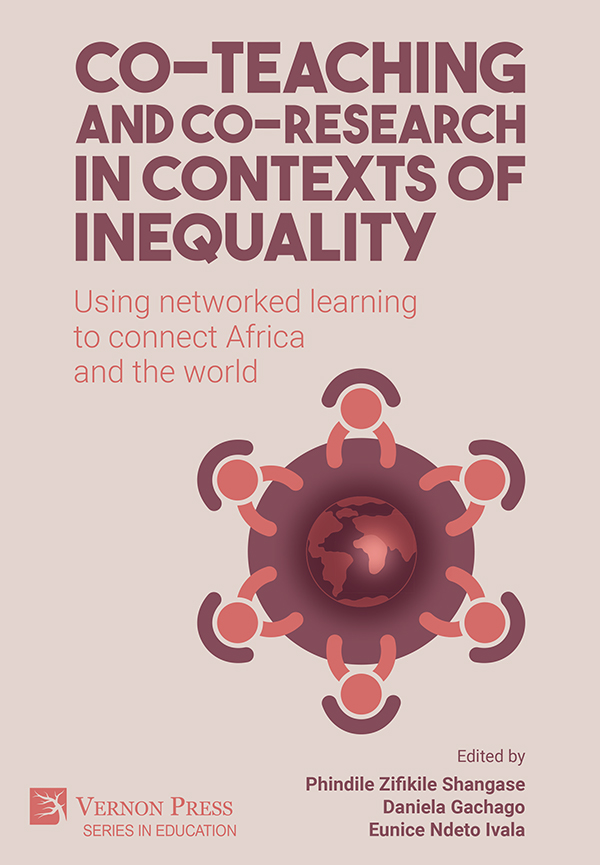
Using networked learning to connect Africa and the world
Edited by: Phindile Zifikile Shangase (University of the Free State, South Africa), Daniela Gachago (University of Cape Town, South Africa), and Eunice Ndeto Ivala (Cape Peninsula University of Technology, South Africa)
There has been a recent surge of interest in the concept of co-teaching and co-research across institutions of HE locally and globally, as a response to limited international mobility due to COVID-19. We see co-teaching and co-research as teaching and research that connects educators and learners across different institutions and different contexts, be it across South Africa, Africa or the world. Co-teaching and co-research is linked in this book to the term ‘networked learning’, following the Networked Learning Editorial Collective’s emphasis on relationships and collaboration rather than technology and foregrounding our strong commitment to social justice. Our collective experiences have shown that co-teaching and co-research are not easy endeavours, especially when they involve differently positioned and differently resourced contexts, students and academics. While these collaborations are enriching and exciting, they need careful support, preparation and time for sustained relationship building – topics that we find are not necessarily discussed in the literature around co-teaching and co-research. This book is an attempt towards closing this gap in knowledge by providing a range of chapters documenting personal experiences of academics and practitioners engaging in co-teaching and co-research across the African continent and beyond, facilitated by various networked learning tools and technologies. Framed by a spirit of sharing and connection, the book provides insights into the benefits and challenges of such collaborations, affordances of technologies to bridge unequal divides, emerging practices of continental collaboration and beyond. Additionally, the book provides an unusually honest and nuanced view on co-teaching and co-research across contexts of inequalities, foregrounding relationship- and community-building rather than technology and emphasising the importance of sustained connection and reflection in these collaborations. Applying a wide range of critical theoretical frameworks, these evidence-based but also reflective and reflexive contributions are a unique and important reminder that behind and through our screens, we connect as humans who yearn to learn from each other, but also need to learn how to learn from each other, when we do not share the same world views.
Edited by: Laura M. Pipe (University of North Carolina at Greensboro) and Jennifer T. Stephens (Elon University)
Social justice frameworks and pedagogical practice have become popular concepts within educational settings. However, these approaches stop short of the direct action required for true social change and often overlook the impacts and importance of space, place, and culture in the learning process. Through an exploration of justice-forward approaches that call for a blend of equity and culturally-responsive pedagogies with experiential approaches to learning, this edited book will examine the process of unlinking colonizing structures from teaching and learning through honoring the context of space, place, and culture in the learning process. Framed by the Toward a Liberated Learning Spirit (TALLS) Model for Developing Critical Consciousness, this book will be of interest to students, scholars, and researchers in higher education as well as critical and cultural studies, apart from program administrators and educators. 'Ignite: a Decolonial Approach to Higher Education Through Space, Place and Culture' will carry the reader through a learning process beginning with academic detachment and moving through a process of unlearning toward embodied liberation.
Edited by: Sara Tours (University of Pennsylvania) and Jeremy M. Lynch (Slippery Rock University)
Globally, and within the United States, we continue to progress toward a more diverse and inclusive culture. This fact is perhaps reflected nowhere better than in the public school system in the United States, where, by 2029 (NCES, 2020), non-white students will outnumber white students in classrooms. The challenges that the current system of education confronts in ensuring equitable access and equal achievement are also well-documented (Darling-Hammond, 2015). A key component in the re-shaping and development of a more equitable and inclusive system are the pre-service teachers enrolled in our college and university teacher preparation programs across the country. As we prepare for the diverse classrooms of the future, we need to prepare the teachers of the future to not only be able to teach all students but to also have the cultural competencies to ensure the same access and opportunities are provided to all students. It has been well documented (Cunningham, 2015; Lupi & Turner, 2013) that international education experiences, or international field experiences, have a positive effect on both the professional development and cultural competencies of pre-service teachers. Across a wide range of performance outcomes, pre-service teachers with international field experiences are better equipped to enter the field (DeVillar & Jiang, 2012) and may even persist longer in the profession (Egeland, 2016). However, not all international experiences provide the same positive outcomes. In this book, we will explore the importance of developing culturally competent educators in the United States education system, the research that supports the benefits of international education experiences, and how to develop effective international education experiences that will prepare pre-service teachers for the classrooms of the next decade and beyond.
Edited by: Martina Vranova (Brno University of Technology, Czech Republic)
As Languages for Specific Purposes have always been defined as student-oriented, the rationale behind this volume is to use the rather neglected niche of the other necessary agent of language instruction and thus focus on the LSP practitioner. This turn towards the instructor has been motivated by the fact that a great number of LSP practitioners enter their jobs without previous expertise. They lack LSP education, or they may not even have a background in applied linguistics. This motivation has proven valid as many of the volume’s contributors have faced this particular situation in their professional lives. For insights into the LSP field and guidelines on the best practices, they must rely on their colleagues who offer to share their experience through workshops, conferences, or papers, which is what this volume provides. The primary goal of this volume is to present considerations of what challenges LSP practitioners face and should be prepared for in their jobs and to provide practice-tested methodological guidelines on such demanding teaching techniques as blended and flipped learning or tandem learning. All papers have been written by LSP practitioners and researchers in higher education. Thus, this volume provides both guidance and self-reflection. In other words, it is written by experienced LSP practitioners for aspiring LSP practitioners about how they see themselves and what effort they make to meet the challenges of their jobs. As proof that LSP practice is a global challenge, papers have been collected from many European countries, the USA, Uruguay. Even though most papers are naturally concerned with English, being the lingua franca of today, the collection also features guidelines for teaching Spanish, French and Dutch for specific purposes. Moreover, the target disciplines these languages are taught for encompass business, engineering, sociology or medicine, thus supporting the assumption of the universal character of problems LSP practitioners deal with.
Edited by: Carmela B. Scala (Rutgers University)
In a world that moves at a speed that only a few years ago seemed impossible to achieve, our students are used to having the universe at their fingertips and breathing technology. As educators in the 21st century, we need to understand its impact on society, especially on our students’ learning experience, and find a way to make it work to our, and most importantly, their advantage. This edited volume presents some inspiring research in second language acquisition, focusing on active learning, cooperative and collaborative approach, and other innovative strategies to engage the students and promote learning.
Edited by: Cuthbert Majoni (Zimbabwe Open University, Zimbabwe)
'Leading and Managing Open and Distance E-Learning (ODeL) Institutions in Africa' focuses on e-learning, especially in developing countries in Africa. The outbreak of COVID-19 has forced most educational institutions, including conventional institutions in higher education, to embrace e-learning as a tool to ensure that education is not paralysed but continues to thrive. However, the major challenge has been shifting focus from the conventional face-to-face mode to the e-learning mode. This calls for a change of mindset and a review of practices to ensure success in implementing e-learning. This book has 12 chapters that explore the leadership theories and approaches that influence administrative practices in ODeL institutions, as well as student support within library and information services, the complexities of student affairs, the inclusion of students with special needs, the contemporary issues of innovation and industrialisation, and effective marketing techniques for the survival and growth of tertiary institutions. It is hoped that the recipients of this book can acquire the theoretical and practical knowledge relevant to the successful implementation of e-learning.
A Guide for K-12 Teachers and Service Providers
By: Daniel T. Sciarra (Hofstra University) and Vance L. Austin (Manhattanville College)
This text is designed to help teachers and service providers work successfully with children who exhibit emotional and behavioral disorders by affording them a repertoire of valuable, evidence-based treatment strategies. Furthermore, because the book represents a synthesis of expertise, written from the dual perspectives of an experienced clinician and an educator, the school professional who reads it will better understand the role of both teacher and service provider, thus optimizing the coordination and effectiveness of the services that are critical to the success of these students. ‘Working with Students with Emotional and Behavioral Disorders: A Guide for K-12 Teachers and Service Providers’ explores the most prevalent behavioral disorders encountered by school professionals as they work with today’s students. These high-incidence behavioral disorders are addressed by type, and each includes a discussion of the relevant characteristics, causes, prevalence, and treatment strategies. Features that are unique to this book include its acknowledgement of the need for a collaborative approach to these problems by all school professionals, as well as the coordination of services provided by the classroom teacher and other service providers working with these students. To date, few books, if any, have provided this holistic perspective. This book is designed to help K-12 teachers and related service providers (i.e., school psychologists, school social workers, speech-language pathologists, guidance counselors, and occupational therapists) work successfully with children who exhibit emotional and behavioral disorders by affording them a repertoire of valuable, evidence-based treatment strategies.
Edited by: Raymond M. Klein (Nova Scotia College of Art and Design University)
The Drawing Laboratory at NSCAD University was founded with funding from the Social Sciences and Humanities Research Council of Canada in 2005 as a collaboration between psychological scientists from Dalhousie and drawing instructors at NSAD. The Drawing Lab is thus a unique place where scientists and artists collaborate on interdisciplinary research about the complex intellectual and practical act of drawing from observation. By bringing the scientific method to bear on how drawing processes unfold, those involved seek to improve drawing education while furthering research on the cognitive processes involved in drawing. The chapters in this book describe that research. ‘Perceptual and Cognitive Processes in Drawing from Observation’ will hold much interest for drawing instructors and students, psychologists and neuroscientists with a specialism in art, as well as those with a general interest in art and science. Authors of this volume are Amanda Burk, John Christie, Tim Fedak, Raymond Klein, Geniva Liu, Bryan Maycock, Mathew Reichertz and Jack Wong.