Loading...
Please wait while we load the content...

Loading...
Please wait while we load the content...
Loading...
Please wait while we load the content...
Explore peer - reviewed titles across the humanities and social sciences - rigorous research, fresh perspectives, and scholarship that inspires dialogue across disciplines.
Stay informed about our latest publications, calls for proposals, author news, events, and special announcements.
Join our community of scholars, librarians, authors, and readers and receive the latest updates from Vernon Press directly in your inbox.

From special discounts and global distribution partners to downloadable catalogs, flyers, and high-resolution covers, we make it easy to enrich your library’s collection. Access bibliographic data, explore subject-specific listings, and stay updated on forthcoming titles.
Become part of our librarian network and access dedicated tools, discounts, and resources to support collection development and promote new titles to your patrons.

Partner with Vernon Press to provide your customers with high-quality, peer-reviewed scholarship. We offer flexible ordering options, reseller agreements, and promotional materials to support your sales and outreach.

Vernon Press provides dedicated resources to help instructors adopt our books for courses and to support students with affordable access to high-quality scholarship. From desk and examination copies to tailored student editions, we aim to make our titles accessible in the classroom.
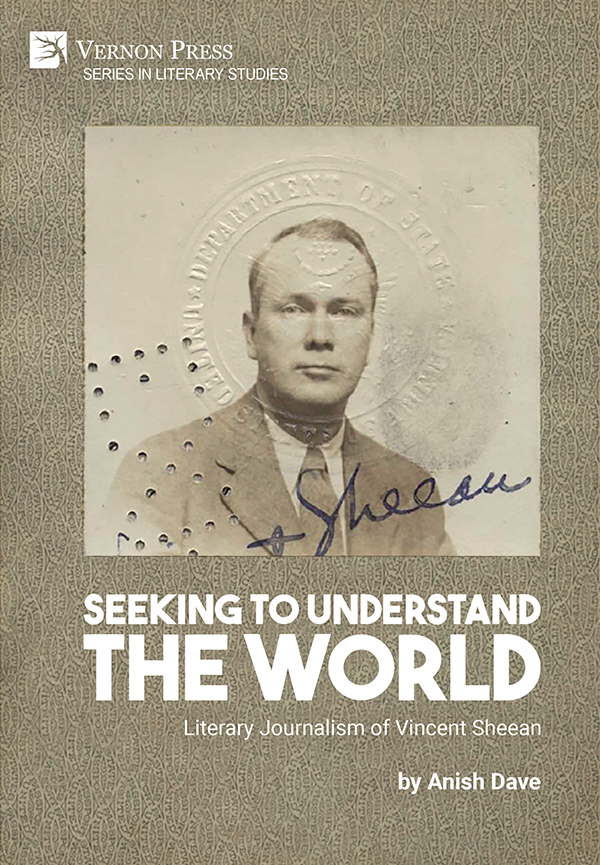
By: Anish Dave (Stephen F. Austin State University)
Vincent Sheean, a groundbreaking American foreign correspondent and author, is known for reporting from Europe, North Africa, and Asia, writing news reports, articles, and books. A few books and articles have described Vincent Sheean’s life, and briefly discussed his major nonfiction books. However, no book-length study or article has closely examined his nonfiction books. 'Seeking to Understand the World: Literary Journalism of Vincent Sheean', textually analyzes his five nonfiction, journalistic books to examine them for characteristics of literary journalism. Spanning nearly the entirety of his journalistic career, these books include 'Personal History' (1935), 'Not Peace but a Sword' (1939), 'Between the Thunder and the Sun' (1943), 'Lead, Kindly Light' (1949), and 'Nehru: The Years of Power' (1960). Set in different world areas, the books illuminate events as disparate as the Riffian war, the Spanish Civil War, the infamous Munich pact, the Nazi bombing of London, and the assassination of Mahatma Gandhi. Sheean’s books provide an in-depth, personal look at these and related events. This book includes analysis of Sheean’s works, finding that they have several prominent characteristics of literary journalism: stories and scenes, cohesive structure, lifelike characters, vivid description, well-crafted sentences, immersive reporting, among others.
Edited by: Emily Strand and Amy H. Sturgis
After more than 55 years of transmedia storytelling, 'Star Trek' is a global phenomenon that has never been more successful than it is today. 'Star Trek' fandom is worldwide, time tested, and growing, and academic interest in the franchise, both inside and outside of the classroom, is high; at the moment, more 'Star Trek' works are underway or in development simultaneously than at any other moment in history. Unlike works that focus on a limited number of stories/media in this franchise or only offer one expert’s or discipline’s insights, this accessible and multidisciplinary anthology includes analyses from a wide range of scholars and explores 'Star Trek' from its debut in 1966 to its current incarnations, considers its implications for and collaborations with fandom, and trace its ideas and meanings across series, media, and time. 'Star Trek: Essays Exploring the Final Frontier' will undoubtedly speak to academics in the field, students in the classroom, and informed lay readers and fans.
Edited by: Rachel L. Carazo (St. Thomas University)
This volume adds to previous historical and political studies about 'Gladiator' with essays about the movie’s relation to pop culture and contemporary discourses. It not only relates 'Gladiator' to traditional cinema aspects such as heroism, music, acting, studio culture, and visual effects, but it also connects the film to sports, religion, and the environment, expanding the ways in which the film can be evaluated by modern audiences. The volume can be read by individuals or in classroom settings, especially as a recommended text for students studying the ancient world in film.
By: Giovanni Brancato (Sapienza University of Rome, Italy)
Los jóvenes, la política y los medios de comunicación son los tres pilares que sostienen la investigación objeto de este volumen dedicado al estudio de los efectos producidos en las audiencias televisivas, en términos de confianza en la política y sus protagonistas, tras la exposición a contenidos mediáticos “conflictivos”. El libro intercepta un tema muy importante y de gran actualidad en tiempos en los que la sociedad se caracteriza por un sentimiento de cinismo, por una parte, y por la proliferación de fenómenos políticos populistas, por otra. Además, la elección de analizar el contexto político y mediático ecuatoriano cómo caso de estudio hace que este trabajo de investigación sea único entre las contribuciones académicas en el campo de los estudios e investigaciones al respecto en las ciencias de la comunicación y la sociología política. El volumen se divide en dos partes. La primera sección está dedicada a las relaciones entre los medios de comunicación, los ciudadanos y la política en la era de la desconfianza generalizada. En particular, se analizará la evolución de la comunicación política tras la aparición de la televisión y en los posibles efectos de los medios en los hábitos y prácticas informativas y política de los ciudadanos, centrándose en la sociedad ecuatoriana en los últimos veinte años. La segunda parte del libro presenta las fases de trabajo y los resultados de la investigación en campo llevada a cabo por el autor, caracterizada por un diseño cuasiexperimental, con el objetivo de analizar las dinámicas conflictivas típicas del debate en los talk shows y sus relaciones con los posibles efectos en las audiencias sobre el nivel de cinismo público.
By: Alfonso J. Garcia-Osuna (Hofstra University)
'The Atlantic as Mythical Space' is a study of medieval culture and its concomitant myths, legends and fantastic narratives as it developed along the European Atlantic seaboard. It is an inclusive study that touches upon early medieval Ireland, the pre-Hispanic Canary Islands, the Iberian Peninsula, courtly-love France and the pagan and early-Christian British Isles. The obvious and consequential ligature that runs throughout the different sections of this text is the Atlantic Ocean, a bewildering expanse of mythical substance that for centuries fueled the imagination of ocean-side peoples. It analyzes how and why myths with the Atlantic as preferential stage are especially relevant in pagan and early-Christian western Europe. It further examines how prescientific societies fashioned an alternate cosmos in the Atlantic where events, beings and places existed in harmony with communal mental structures. It explores why in that contrived geography these societies’ angels and monsters were able to materialize with wonderful profusion; it further analyzes how the ocean became a place where human beings ventured forth searching for explanations for what is essentially unknowable: the origins of the universe and the reason for our existence in it.
Edited by: Jorge Serrano (University of Delaware)
This interdisciplinary academic study is for readers interested in film, media, and the comic book genre. Superhero theories are abundant, especially considering their use as a tool for coping with adversity, and some note that it is an integral part of American society, young formative minds, in particular. It is not just about learning morals but also seeing how an ideal society should function and look. There are works that review superheroes and theories about comic book series adaptions in film and text, but the writers in this compendium engage not only with the film and the intersectionality of women, Asian culture, Du Bois, and even Greek Ajax and others for comparison but also comparative analysis of works that capture African and African diasporic representation throughout various historical time periods. The anthology presents discourse that engages a variety of assessments that involve questions of positive and pejorative representation. Educators will find this a useful tool for undergraduate students as well as general audiences interested in this popular film/comic series.
Edited by: Chris McGunnigle (Seton Hall University)
Gamification is an up and coming popular trend in all levels and types of education, including public and private schools, higher education, the military, the private sector, and elsewhere. Gamification introduces aspects of game design like teamwork, competition, rewards and prizes, storytelling, and more into lesson plan units. In many cases, actual games, whether it be Scrabble, Hangman, Candy Crush, Dungeons & Dragons, and many others, are adapted into educational tools. This chapter collection will specifically look at the use of gamification techniques in Freshmen Writing courses and related Composition, Writing and Rhetoric classes. Each chapter will provide sample gamified lessons supported by relevant scholarship in both Gamification Theory and Writing Studies.
Edited by: Nicole De Brabandere (McGill University)
This volume gathers research at the intersection of art and the interdisciplinary humanities to develop an understanding of media assemblages that insist on the generativity of their situatedness within ecologies of practice. These contributions propose media assemblages that enlarge the time and space for co-compositions between media and bodies that reshape subjective, perceptual, and affective registers of experience. Media assemblages include photography, performance, criticism, curation, installation, animation, collage, video and VR, as well as archival and somatic practices. Research as a form of practice is a key orientation in this volume since it offers a means of engaging the world-making proposition offered by Isabelle Stengers that practices are specified through irreducible entanglements that cause one to think, feel, and hesitate. The generative linkages between different disciplinary approaches for engaging research practice across the arts and humanities are favoured over disciplinary and media-based exclusivity. When practice is not posed as an intervention or counterpoint to scholarly research or in opposition to the discursive, differences emerge, not based on convention but through the situatedness of emergent insight. The goal is thus not to forward a reproducible formula for knowledge creation but to weave the conditions for utterances both within and in excess of discipline, convention, and establishment. How can research engender the making of communities between, across, and in excess of institutional frameworks through the emergent affinities, postures, and formats of evolving and inclusive forms of research? This volume is a valuable reference for researchers/practitioners within the arts and humanities as it exemplifies both critical and situated methods for developing interdisciplinary research as a means of transforming the terms of research itself.
Edited by: Jordan Frith (Clemson University) and Michael Saker (City University London)
VR occupies an interesting place in the media ecosystem. On the one hand, it is an emerging, ‘cutting-edge’ technology backed by billions of USD by major corporations. On the other hand, VR is older than the World Wide Web and older than social networking sites. After many years of hype and unfulfilled potential, VR is now finally on the precipice of widespread adoption and has begun to be used in novel ways throughout various industries. This edited collection brings together a diverse group of authors to analyse the current state of VR, while recognizing that these many different use-cases will likely become even more important with the increased investment in the technology. To examine the current state of VR across multiple sites and industries, we compiled a group of practitioners and academics to both examine VR practices and theorize new uses of VR. The book also focuses on an inclusive analysis and includes authors from South America, North America, Europe, Australia, and Asia, and the topics range from analyses of VR use in live events to the ethics of nature-based VR apps to the social practices involved in using public VR at museum exhibits. As we argue in the introduction, this book is one of the first to bring together authors from different backgrounds and disciplines to chart just how widely VR has already spread. And maybe most importantly, the topics covered in this book will only become more relevant as VR continues to grow, especially in the wake of the growth of the supposed Metaverse.