Loading...
Please wait while we load the content...

Loading...
Please wait while we load the content...
Loading...
Please wait while we load the content...
Explore peer - reviewed titles across the humanities and social sciences - rigorous research, fresh perspectives, and scholarship that inspires dialogue across disciplines.
Stay informed about our latest publications, calls for proposals, author news, events, and special announcements.
Join our community of scholars, librarians, authors, and readers and receive the latest updates from Vernon Press directly in your inbox.

From special discounts and global distribution partners to downloadable catalogs, flyers, and high-resolution covers, we make it easy to enrich your library’s collection. Access bibliographic data, explore subject-specific listings, and stay updated on forthcoming titles.
Become part of our librarian network and access dedicated tools, discounts, and resources to support collection development and promote new titles to your patrons.

Partner with Vernon Press to provide your customers with high-quality, peer-reviewed scholarship. We offer flexible ordering options, reseller agreements, and promotional materials to support your sales and outreach.

Vernon Press provides dedicated resources to help instructors adopt our books for courses and to support students with affordable access to high-quality scholarship. From desk and examination copies to tailored student editions, we aim to make our titles accessible in the classroom.
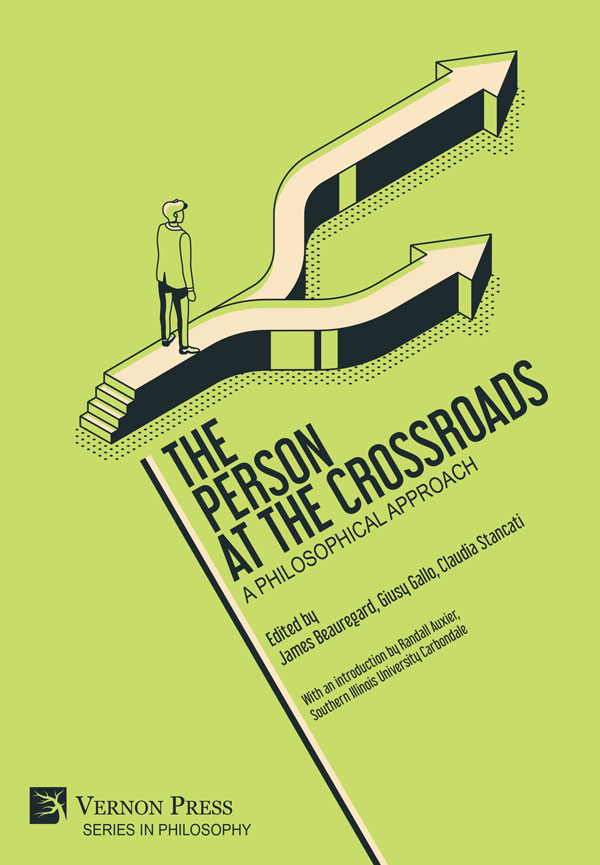
Edited by: James Beauregard (Rivier University), Claudia Stancati (University of Calabria, Italy), and Giusy Gallo (University of Calabria, Italy)
‘The Person at the Crossroads: A Philosophical Approach’ brings together scholars from around the world who share a common interest in the nature and activity of the human person. Personhood is examined from a variety of perspectives, both philosophical and theological, drawing on the rich traditions of both Western and Eastern thought. Readers will find themselves on a journey through the works of past and current scholars including, Confucius, Augustine, David Hume, Immanuel Kant, Horace Bushnell, Maurice Merleau-Ponty, Michael Polanyi, Rudolf Carnap, Karol Wojtyla, Erazim Kohak, and many other authors who touch upon the personalist tradition and the human person. This volume will be of particular interest to readers interested in the nature of the human person, as well as philosophy and theology undergraduate and graduate students and professors teaching in these areas.
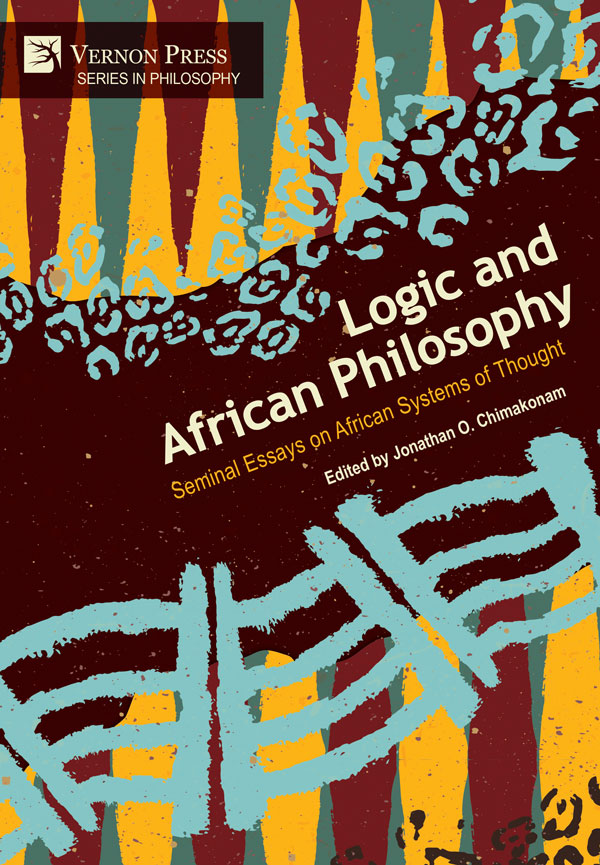
Seminal Essays on African Systems of Thought
Edited by: Jonathan O. Chimakonam (University of Pretoria, South Africa)
“Logic and African Philosophy: Seminal Essays on African Systems of Thought” aims to put African intellectual history in perspective, with focus on the subjects of racism, logic, language, and psychology. The volume seeks to fill in the gaps left by the exclusion of African thinkers that are frequent in the curricula of African schools concerning history, sociology, philosophy, and cultural studies. The book is divided into four parts that are preceded by an introduction to link up the essays and emphasise their sociological implications. Part one is comprised of essays that opened the controversy of whether logic can be found in traditional African cultures as well as other matters like the nature of the mind and behaviour of African peoples. The essays in part two are centred on the following question: are the laws of thought present in African languages and cultures? Part three brings together essays that sparkle the debate on whether there can be such a thing as African logic, which stems from the discussions in part two. Part four is concerned on the theme of system-building in logic; contributions are written by members of the budding African philosophy movement called the “Conversational School of Philosophy” based at the University of Calabar, and the main objective of their papers is to formulate systems of African logic.
By: Piotr Stankiewicz (University of Warsaw, Poland)
This book is a manifesto of reformed Stoicism. It proposes a system of life which is bullet-proof, universal, viable and effective in every cosmic setting. It holds in every possible universe, under any government and within any economic system. We can be reformed Stoics no matter what we believe in. Reformed Stoicism is about enjoying and exercising our agency. In other words, it’s about the flow of making autonomous and right decisions, and about celebrating our ability to make them. With no reliance on nature, with the recalibration of metaphysical positions, with skepticism towards grand discourses and universal answers, with an emphasis on the usefulness instead of truthfulness of narratives, with no reference to the vanity argument, with criticism of both conservative and ascetic misinterpretations of Stoicism, with an overall softer and more empathic approach, we can no longer be defined by the generic term “Stoicism”. Our time, in short, calls for a fresh interpretation of Stoicism. It is time for a new generation of Stoics. Thus: reformed Stoicism.
Edited by: Christopher Hrynkow (University of Saskatchewan)
By taking a religiously and spiritually literature approach, this volume gets the heart of several emerging ethical issues crucial to both human identity and personhood beyond the human as technology advances in the areas of human enhancement and artificial intelligence (AI). Several significant questions are addressed by the contributors, such as: How far should we go in improving our biological selves? How long should we aspire to live? What are fair and just human enhancements? When will AIs become people? What does AI spirituality consist of? Can AIs do more than project humour and emotions? What are the religious undertones of these high technology quests for better AI and improved human existence? Established and emerging voices explore these questions, and more, in Spiritualities, ethics, and implications of human enhancement and artificial intelligence. This volume will be of interest to university students and researchers absorbed by issues surrounding spiritualities, human enhancement, and artificial intelligence; while also providing points for reflection for the wider public as these topics become increasingly important to our common future.
By: Basil Evangelidis
'Reason, Causation and Compatibility with the Phenomena' strives to give answers to the philosophical problem of the interplay between realism, explanation and experience. This book is a compilation of essays that recollect significant conceptions of rival terms such as determinism and freedom, reason and appearance, power and knowledge. This title discusses the progress made in epistemology and natural philosophy, especially the steps that led from the ancient theory of atomism to the modern quantum theory, and from mathematization to analytic philosophy. Moreover, it provides possible gateways from modern deadlocks of theory either through approaches to consciousness or through historical critique of intellectual authorities. This work will be of interest to those either researching or studying in colleges and universities, especially in the departments of philosophy, history of science, philosophy of science, philosophy of physics and quantum mechanics, history of ideas and culture. Greek and Latin Literature students and instructors may also find this book to be both a fascinating and valuable point of reference.
Edited by: Thomas Claviez (University of Bern, Switzerland), Kornelia Imesch (University of Lausanne, Switzerland), and Britta Sweers (University of Bern, Switzerland)
The volume provides a critical assessment of the concept of authenticity and gauges its role, significance and shortcomings in a variety of disciplinary contexts. Many of the contributions communicate with each other and thus acknowledge the enormous significance of this politically, morally, philosophically and economically-charged concept that at the same time harbors dangerous implications and has been critically deconstructed. The volume shows that the alleged need or desire for authenticity is alive and kicking but oftentimes comes at a high price, connected to a culture of experts, authority and exclusionary strategies.
On the Occasion of the 70th Anniversary of the UDHR
Edited by: Luca Di Donato (State Professional School B. Cavalieri, Italy) and Elisa Grimi
The 1948 Declaration of Human Rights demanded a collaboration among exponents from around the world. Embodying many different cultural perspectives, it was driven by a like-minded belief in the importance of finding common principles that would be essential for the very survival of civilization. Although an arduous and extensive process, the result was a much sought-after and collective endeavor that would be referenced for decades to come. Motivated by the seventieth anniversary of the 1948 Universal Declaration of Human Rights and enriched by the contributions of eminent scholars, this volume aims to be a reflection on human rights and their universality. The underlying question is whether or not, after seventy years, this document can be considered universal, or better yet, how to define the concept of “universality.” We live in an age in which this notion seems to be guided not so much by the values that the subject intrinsically perceives as good, but rather by the demands of the subject. Universality is thus no longer deduced by something that is objectively given, within the shared praxis. Conversely, what seems to have to be universal is what we want to be valid for everyone. This volume will be of interest to those currently engaged in research or studying in a variety of fields including Philosophy, Politics and Law.
By: Jeremy Sampson (University of Aberdeen, Aberdeen, Scotland, UK)
Are we being played? Is our understanding of the traditionally fixed and static concepts of philosophy based on an oversimplification? This book explores some of the theories of the self since Descartes, together with the rationalism and the empiricism that sustain these ideas, and draws some startling conclusions using Gadamer’s philosophical study of play as its starting point. Gadamer’s ludic theory, Sampson argues, reveals a dynamic of play that exists at the deepest level of philosophy. It is this dynamic that could provide a solution in relation to the Gadamer/Habermas hermeneutics debate and the Gadamer/Derrida relativism debate, together with a theory of totality. Sampson shows how ludic theory can be a game-changer in understanding the relationship between philosophy and literature, exploring the dynamic between the fictive and non-fictive worlds. These worlds are characterized simultaneously by sameness (univocity of Being) and difference (equivocity of Being). The book questions Heidegger’s idea that the univocity of Being is universal, instead maintaining that the relationship between the univocity of Being and equivocity of Being is real, and that ontological mediation is required to present them as a unified whole. Using the works of Shakespeare, Beckett and Wilde, Sampson contends that such a mediation, termed ‘the ludicity of Being’, takes place between literature and its audience. This literary example has profound implications not only for literature and its attendant theories but also for philosophy — in particular, ontology and hermeneutics. This book will be of particular interest to scholars of philosophy and literature, for it seeks to develop our understanding of ontology and hermeneutics. It should also engage the general reader who wishes to understand literature and philosophy with a genuinely new set of perspectives.
From the Buddha to Omar Khayyam
By: Mostafa Vaziri (University of Innsbruck, Austria)
The critical narrative of this interdisciplinary book offers a first-time look at the interrelationship between biology, mythology and philosophy in human development. Its daring premise follows the trajectory of human thought, starting with the biological roots of fear and the original need for religion, truth-seeking, and myth-making. The narrative then innovatively links a number of maverick philosophical teachings over the centuries, from pre-Buddhist times to the Buddha, from Epicurus and Pyrrho to Lucretius, and eventually to the seminal poetry of Omar Khayyam. These emergent philosophies exemplified liberation from the grasp of mythical and religious thinking and instead espoused an empirical and joyful mind. The narrative concludes with a look at the emancipating philosophical movement that resulted in the European Enlightenment, and it suggests that the philosophical teachings explored in the book may offer the potential for a second, broader Enlightenment.