INDEPENDENT PUBLISHER OF BILINGUAL SCHOLARLY BOOKS IN THE HUMANITIES AND SOCIAL SCIENCES

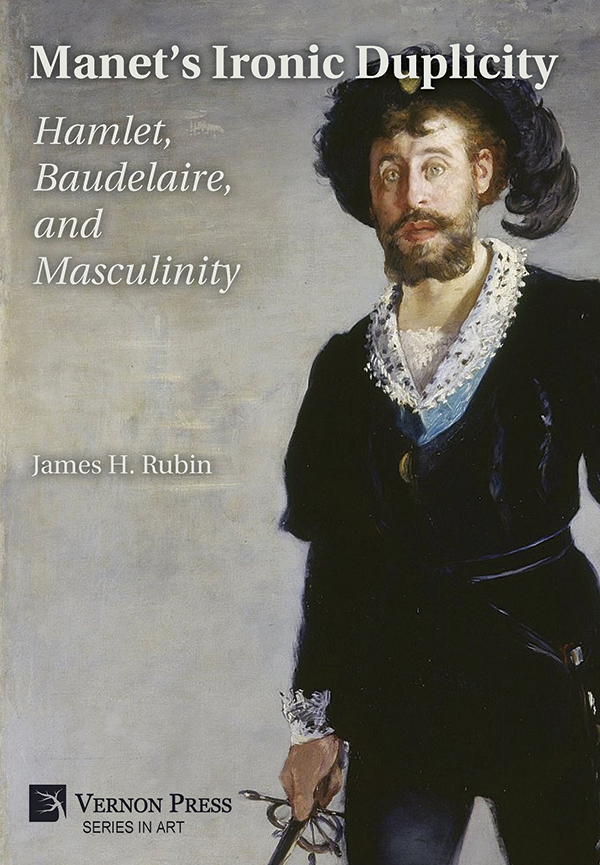
Manet’s Ironic Duplicity: Hamlet, Baudelaire, and Masculinity

by James H. Rubin (Stony Brook, State University of New York)

Purchase this book

Hardback
$ 129
Availability: Forthcoming

James Rubin is well-established as a major voice in the highly contested field of Manet scholarship, and this book will further our understanding of Manet’s impact on modernism. The text is beautifully written with a well-crafted and original take on Manet and masculinity. His analysis of the history of role playing and pseudonyms in the French tradition solidifies his argument. His insertion of Durkheim is superb and highly innovative without ever lapsing into jargon. His take on the Manet-Morisot relationship is newly intriguing and entirely convincing. He manages to deepen our understanding with his deft and provocative readings of images. The book presents complex research by making particular cases such as his focus on Hamlet visually and thematically emblematic of larger issues.

Dr. Therese Dolan
Tyler School of Art, Department of Art History
Temple University


The author has put forward a remarkably compelling and persuasive argument for the central place of performance, various forms of duplicity and duality, and notions of masculinity in Manet’s work, life, and sense of self. The author’s analysis of Baudelaire’s work, the relationship between Baudelaire’s and Manet’s ideas, and the connections of both to their historical moments are also profoundly meaningful contributions to the existing literature, as is the highly illuminating positioning of Manet’s work in relation to Baudelaire’s writings on acting and their relevance to the writer’s views on visual art. Of great value is also the author’s in-depth, sophisticated, and wonderfully original interpretation of the multi-layered significance of Manet’s representations of Hamlet. While conceptually complex, the author's arguments are articulated in an accessible manner, with clear interpretive threads that run throughout the manuscript that tie the chapters together and make the text as a whole feel argumentatively consistent and cohesive.

Dr. Michelle Foa
Art History, Newcomb Art Department
Tulane University

The painter Edouard Manet (1832-1883) was a central figure for momentous and lasting changes in the realm of art that still resound today. His art speaks directly to the philosophical issues and political conflicts of his own time and is therefore deeply embedded in the development of modernity. 'Manet’s Ironic Duplicity' focuses on that situation and the historically conscious artist’s sometimes ambivalent struggle for authenticity. Rather than another full chronological monograph, the book is an interdisciplinary study organized around key concepts. It reframes the major, and sometimes disparate issues in Manet scholarship by focusing on a never-before-considered overriding theme—duplicity—which itself is multiple in its manifestations and variants, hence 'duplicities'. Reversing the usual narrative, this study deconstructs and enlightens the myth of the heroic artist struggling for individual and original vision by revealing how so much of Manet’s creativity and irony was prompted by frustrations due to repressive politics, censorship, and challenges to his sense of self. A key aspect of the latter was his masculinity.
Although Manet’s association with the ideas of the poet and critic Charles Baudelaire is well known, never has Baudelaire’s essay 'On the Essence of Laughter and the Comic in the Visual Arts' been brought to bear on the concept of irony in Manet’s work. Given Baudelaire’s rapprochement between actors and artists, as well as Manet’s familiarity with the theatrical milieu, the book focuses on Manet’s two little-studied representations of 'Hamlet' as both the starting and end point of its analysis. It then concludes with a re-reading of the painter’s illustrated letters to women as a dissimulation of his final, fatal illness in order to maintain his masculine honor.

James Rubin is one of the world’s foremost specialists in the history, theory, and criticism of nineteenth-century avant-garde European Art, especially that of France. His interests are interdisciplinary, with special attention to cultural history, art and politics, and art and philosophy. Born in Cambridge, Massachusetts, he was taken by his mother to Boston’s Museum of Fine Arts and the Isabella Stewart Gardner Museum at a young age. He was educated at Phillips Academy Andover, where he discovered the Addison Gallery, and Yale (B.A.), where he first discovered art history. From there, and during the Vietnam War, he went to Paris to study at the Institut d’Art et d’Archéologie of the Sorbonne (license-ès-lettres in art history), returning to Harvard University for his PhD (1972). He has taught at Harvard, Boston University, Princeton University, The Cooper Union, and Stony Brook, the State University of New York, from which he is now retired. He has published over 70 articles and essays on subjects ranging from the eighteenth century to the present. He has given over 80 public lectures in North America, Western and Eastern Europe, and Asia. He is the author of 16 published books on Impressionism and on artists such as Eugène Delacroix, Gustave Courbet, Edouard Manet, Claude Monet, and Paul Cezanne. Several of these have been translated into other languages, including French, Greek, Korean, Japanese, and Dutch. He travels frequently, speaks fluent French, and lives in Manhattan, New York and Mittelbergheim, Alsace. He is a dual national, married to Liliane Béatrix Braesch of Strasbourg, France. Their son, Henry-Alex, is a cineéaste for Smuggler and a winner of an Oscar nomination and many other awards. Their daughter, Delphine McNeill, is a fashionista and co-founder of Livotte Tops, Ltd. In London. Their Boston Terrier’s name is Texas Pete.

Humor in Manet, painting and theater, French art, Spanish art, performativity, Ambroise Thomas, Jean-Baptiste Faure, Shakespeare, Berthe Morisot, Victorine Meurend, gender, Impressionism, Realism, Gustave Courbet, Manet’s Letters

See also

Bibliographic Information

Book Title

Manet’s Ironic Duplicity: Hamlet, Baudelaire, and Masculinity


ISBN

979-8-8819-0375-6


Edition

1st


Physical size

236mm x 160mm


Publication date

January 2026
SSL