



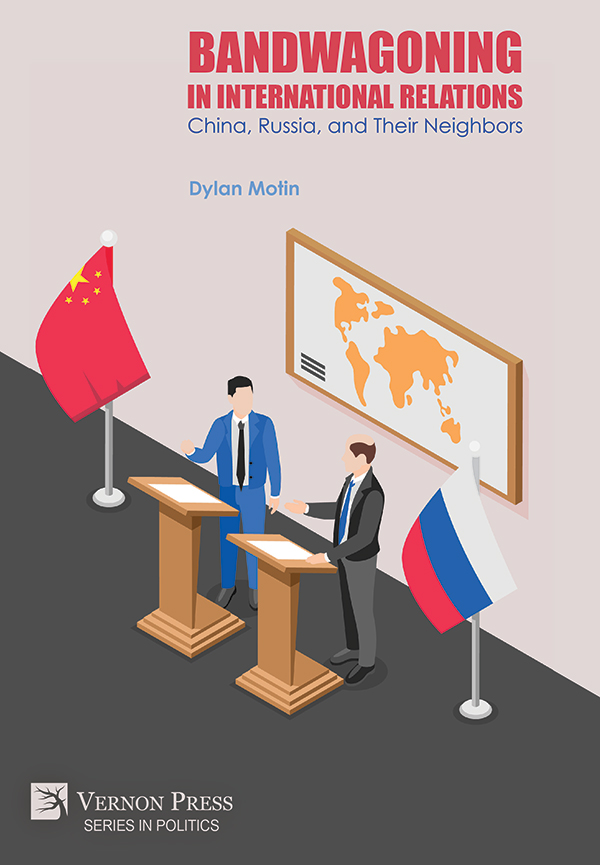
We are pleased to announce that 'Bandwagoning in International Relations: China, Russia, and Their Neighbors' by Dylan Motin (Kangwon National University, Korea) has been reviewed by Christophe Kerdodé in 'Cahiers du Comité Asie Pacifique’ (Jeunes IHEDN association (in French)), 24e Édition. P. 146:
[...] En somme, le livre apporte un éclairage novateur sur le débat entre la stratégie de l’équilibre et celle du ralliement, tout en exploitant de façon originale la littérature néoréaliste existante. Il a également le mérite d’explorer des cas souvent oubliés. L’auteur aborde frontalement des enjeux de politique internationale et propose des recommandations claires pour les décideurs. Cependant, les chercheurs non réalistes et les spécialistes des États ou régions concernés risquent de rester indifférents aux généralisations et recommandations de Motin. Le débat entre l’équilibre des puissances et le bandwagoning reste bien vivant.
[Extract from book review on ‘'Cahiers du Comité Asie Pacifique’ (Jeunes IHEDN association (in French)), 24e Édition. P. 146. Reviewer: Christophe Kerdodé. https://www.jeunes-ihedn.org/2026/les-cahiers-du-comite-asie-pacifique-n24-la-guerre-hors-limites/]
Find out more about the book and order your copy here: Bandwagoning in International Relations: China, Russia, and Their Neighbors
Whether states balance against or bandwagon with threatening great powers remains an unsolved problem for international relations theory. One school argues that military power compels minor powers to accommodate threats, while another defends that it elicits balancing instead. With the emergence of potential hegemons in both Asia and Europe — namely China and Russia — understanding state alignment is more urgent than ever. This book shows that bandwagoning has been a rare choice in contemporary Asia and Europe. The only states that chose bandwagoning with China or Russia faced both conflicts with third rivals and low levels of U.S. assistance. Going further, I divide bandwagoning between full alignment, survival accommodation, and profit accommodation. Bandwagoners choose among these three options based on the severity of the threat posed by the potential hegemon, the intensity of third conflicts, and the level of U.S. assistance. I test this novel theory against three European (Armenia, Belarus, and Serbia) and four Asian (Cambodia, Myanmar, North Korea, and Pakistan) cases. This study is the first to provide an exhaustive and compelling explanation of bandwagoning fully compatible with neorealism and adds to the balancing-bandwagoning debate. Beyond scholarly implications, this research’s findings offer advice for policymakers concerned with the changing balance of power in Asia and Europe and how to counter China and Russia’s influence.