Loading...
Please wait while we load the content...

Loading...
Please wait while we load the content...
Loading...
Please wait while we load the content...
Explore peer - reviewed titles across the humanities and social sciences - rigorous research, fresh perspectives, and scholarship that inspires dialogue across disciplines.
Stay informed about our latest publications, calls for proposals, author news, events, and special announcements.
Join our community of scholars, librarians, authors, and readers and receive the latest updates from Vernon Press directly in your inbox.

From special discounts and global distribution partners to downloadable catalogs, flyers, and high-resolution covers, we make it easy to enrich your library’s collection. Access bibliographic data, explore subject-specific listings, and stay updated on forthcoming titles.
Become part of our librarian network and access dedicated tools, discounts, and resources to support collection development and promote new titles to your patrons.

Partner with Vernon Press to provide your customers with high-quality, peer-reviewed scholarship. We offer flexible ordering options, reseller agreements, and promotional materials to support your sales and outreach.

Vernon Press provides dedicated resources to help instructors adopt our books for courses and to support students with affordable access to high-quality scholarship. From desk and examination copies to tailored student editions, we aim to make our titles accessible in the classroom.
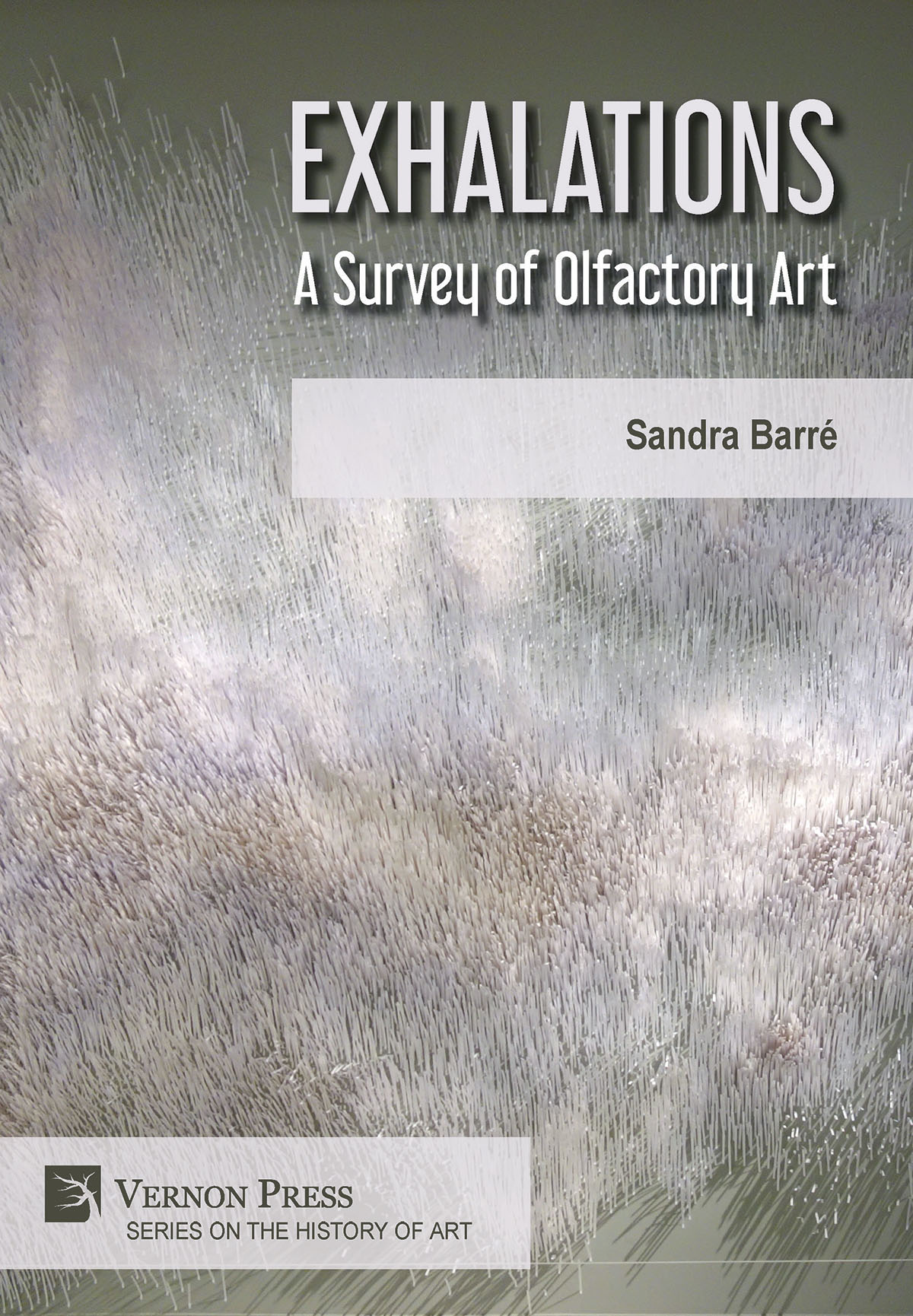
A Survey of Olfactory Art
By: Sandra Barré (Université Paris 1 Panthéon-Sorbonne, France)
What if art history were written through the nose? 'Exhalations: A Survey of Olfactory Art' is the first comprehensive English-language book to trace a century of olfactory practices in art, from the Futurists’ early experiments with scent to the bacterial installations of Anicka Yi, from Marcel Duchamp’s sealed vial of Parisian air to the ecological interventions of Peter de Cupere. Through the analysis of more than one hundred works, Sandra Barré demonstrates the extent to which smell has shaped modern and contemporary artistic practice, despite its persistent marginalization within criticism and institutions. Neither a medium nor a unified movement, olfactory art spans from Dada, Arte Povera, Fluxus, body art, Land Art, feminist practices, to postcolonial critique. Its concerns are equally wide-ranging: memory, desire, decay, gender, and ecological crisis. In doing so, it unsettles the ocularcentrism that has dominated Western art history since the Enlightenment, the assumption that vision constitutes the primary mode of aesthetic knowledge. Smell operates differently. It enters the body immediately, resisting stable interpretation and singular meaning. Two individuals may encounter the same smell and experience entirely different realities, neither of which can be fully privileged over the other. Drawing on archival research, conversations with artists, and years of curatorial practice, 'Exhalations: A Survey of Olfactory Art' is both a historical survey and a history of encounters. The book advances a compelling and overdue argument: that smell has always been present within artistic practice, that it has always carried meaning, and that attending to it transforms our understanding of art history itself. Originally published in French in 2021 by 'Les Éditions de la Lettre Volée', 'Exhalations: A Survey of Olfactory Art' is translated into English by artist Emilie McDermott.
By: Erwin James Casareno
'A Materialist Social Theory of the Idea' advances a unified theoretical framework for understanding how ideas emerge, circulate, and materialize in the world. Rejecting both classical Idealism and reductive Materialism, the book develops a neuromaterialist approach that defines ideas as physically instantiated patterns of neural activity and traces their effects across social, institutional, and material domains. Beginning from the premise that thought is a biological process, the book follows the idea from its origin in the brain through its transmission via language and behavior, its reproduction within culture, and its eventual crystallization in norms, institutions, and physical structures. This recursive process—linking brain, behavior, environment, and social organization—provides a comprehensive model of how ideas function as causal forces in history. Drawing on insights from sociology, philosophy, neuroscience, and political theory, the work introduces original conceptual tools, including models of ideational transmission, activation, and threshold dynamics, as well as the concept of cognitive terraforming to describe the large-scale transformation of reality through ideation. This book offers an interdisciplinary framework for analyzing ideology, social change, and institutional development, making it relevant to scholars and students in social theory, sociology, philosophy of mind, and related fields. It also provides a foundation for further research into the material basis of thought and its role in shaping human behavior and social structure.
Embodiment and the Recovery of Resonance
By: Agata Walek (Brno University of Technology, Czech Republic)
This monograph examines ‘Only Revolutions’ (2006) by Mark Z. Danielewski and ‘Becoming Animal‘ (2010) by David Abram to ask whether contemporary literature can articulate a viable alternative to the radical pluralism and fragmentation associated with postmodern aesthetics. What was once described as the postmodern condition—decentred subjectivity, proliferating interpretations, the dispersal of grand narratives—has intensified in the twenty-first century into algorithmic hyperreality, digital abstraction, and ecological disconnection. Within this landscape, reading and thinking risk dissolving into endless circulation without orientation. Positioned at the intersection of post-structuralism, phenomenology, and embodied cognition, the study proposes not a return to unity but a re-materialization of experience through resonance. It develops an interdisciplinary framework drawing on phonosemantics, conceptual metaphor theory, and sound studies in order to foreground dimensions often marginal in literary criticism: rhythm, vibration, and embodied perception. Language is approached not as a merely representational system but as materially expressive and affectively generative. In a final chapter, the memoir of David Goggins is read alongside these literary and philosophical analyses to explore how discipline, pain, and self-formation enact a comparable structure of re-attunement. Across literary experimentation, ecological phenomenology, and embodied practice, the book argues that meaning does not simply signify—it resounds. By reconceptualizing language as resonant and ontologically expressive, the study offers a constructive response to postmodern fragmentation and contributes to debates in contemporary literary theory, continental philosophy, and embodied cognition. It will be of interest to researchers in literary and cultural studies, philosophy of language, affect theory, and ecophenomenology, and may serve as a methodological resource for interdisciplinary work on materiality, sound, and subjectivity.
A Guide to Samuel Alexander’s 'Space, Time, and Deity'
By: Daniel Paksi (Budapest University of Technology and Economics (BUTE), Hungary)
The universe evolves from a singularity of Space-Time. Life evolves from a singular replicative cell. Mind evolves in a singular living body in every individual case. We are living in an evolving universe. The concept of emergence tries to express the point of this process we can see everywhere. This is the reason that it has become so widespread both in philosophy and science. However, the use and meaning of the concept are quite different in the various fields; we have no real understanding of what the emergence of the universe or life means. The concept of emergence stems from Samuel Alexander’s 'Space, Time, and Deity' (1920). However, no one reads Alexander anymore and thus no one is familiar with the original concept. On the contrary, we often use it in an exactly opposite sense. For example, Lee Smolin, a physicist, to propose a solution for the problems of contemporary physics, writes in his book 'Time Reborn' that the only thing in the universe which is not emergent is Time. However, according to Alexander, we are living in an evolving universe because Time is emergent and the fundament of existence is Space-Time. Time is the ordering principle of change and emergence; there is nothing more. The universe starts with the first manifestation of Time in Space, that is, by a singularity of Space-Time. Matter, life, and mind are all unfolding developments of this process. Every thing or being in the universe is but an emergent spatiotemporal complex. We die because our (biological) time is, in the literal sense, gone. The goal of this book is to present the original concept of emergence in the twenty-first-century modern context, which no one has ever done before, and show that it is perfectly coherent with the scientific discoveries of the last century.
An exercise in post-nation-state worlding
By: Madina Tlostanova (Linköping University, Sweden)
The book is an open-ended, meta-critical reflection on the discrepancy between the nation-state as an institution and contemporary and future (geo)political, social, enviro-climatic, technological and onto-epistemic challenges, written primarily from the position of the systematically excluded from the identification frameworks of the nation-state. Epistemically, the work stems from the decolonial and indigenous critique of coloniality of knowledge and from feminist skepticism towards objectivist, rationalist thinking modes. The author invites the readers to imagine other possible ways of political organization that would contribute to extending life on Earth, and the paths to their implementation. Without aiming at an exhaustive overview of the existing opinions on this vast topic or offering a single correct recipe for the emerging post-state political development, the book experiments instead with various tools, stimulating the readers to relearn how to imagine politically. The established methods, such as thinking together and arguing with authors from different areas and disciplines - from postcolonial studies, decolonial feminist positions to indigenous and libertarian anarchist stances, from critical environmental humanities to techno-fix pseudo-solutions and neo-imperial geopolitical accounts, are intertwined with engaging conversations with political/social/cultural activists, artists and thinkers and with experimental speculative fiction using creative writing as a mode of inquiry. Through its co-creative interactive style, this trans- and post-disciplinary work invites the audience to engage in praxis beyond the actual reading of the book. The book can be used in undergraduate and graduate elective courses in migration studies, critical security studies, human geography, decolonial and postcolonial studies, environmental humanities. It will be of interest to social, political and cultural activists, artists and writers and to broader audiences concerned with the question of whether and how it is possible to live politically beyond the nation-state, without sliding into (neo)imperial, totalitarian or corporate specters.
Texts, Scholarship & Research
Edited by: Alberto Regagliolo (UKSW University)
'Teaching and Learning Classics at the University Level, Vol. 4' focuses on the teaching of literature, digital approaches, and research methodologies in Greek and Roman antiquity. The 14 chapters examine the approaches to teaching key topics, including Digital Humanities, the use of digital tools in the study of antiquity, academic research in ancient history, ancient philosophy and rhetoric, as well as palaeography, codicology, papyrology, and textual criticism. They also explore the teaching of major literary traditions, including Homer, Roman epic poetry, Late Antique Latin literature, and Medieval and Modern Latin drama, as well as innovative approaches such as mapping and employability within Classics. Presenting teaching as a reflective and research-informed activity, this volume is intended for university lecturers, teacher trainers, and graduate students interested in classical literature, digital humanities, and research-based approaches to the study of antiquity in higher education.
Mythology, Arts & Archaeology
Edited by: Alberto Regagliolo (UKSW University)
‘Teaching and Learning Classics at the University Level, Vol. 3’ focuses on the teaching of mythology, arts, and archaeology in Greek and Roman antiquity, with a particular emphasis on cultural expression, visual and material culture, and interdisciplinary approaches. The 9 chapters examine the approaches to teaching key topics including Greco-Roman astrology, classical and comparative mythology, Greek art, numismatics, experimental archaeology, and the study of ancient topography and landscapes, as well as performance and reception through the ancient dramatic chorus and Greek tragedy. The volume also addresses the role of artistic, archaeological, and comparative perspectives within the Humanities, highlighting how visual, material, and performative sources contribute to a broader understanding of antiquity and its reception. Presenting teaching as a reflective and research-informed activity, this volume is intended for university lecturers, teacher trainers, and graduate students interested in mythology, art in its broader sense, archaeology, and the reception of Classical antiquity in higher education.
Society, Religion & Culture
Edited by: Alberto Regagliolo (UKSW University)
‘Teaching and Learning Classics at the University Level, Vol. 2’ focuses on the teaching of social, cultural, and religious aspects of Greek and Roman antiquity. The 11 chapters examine the approaches to teaching key themes in ancient society including ethnography, the human condition and the afterlife, Roman religion, violence, sacrifice, slavery, love, and medicine, as well as aspects of daily life such as play, sport, and bathing culture. The volume also addresses the place of social and cultural history within the Humanities, highlighting how these topics contribute to a broader understanding of antiquity and its relevance today. Presenting teaching as a reflective and research-informed activity, this volume is intended for university lecturers, teacher trainers, and graduate students interested in classical civilization, ancient history, and the cultural and religious dimensions of Greek and Roman studies in higher education.
Artificial Intelligence, Adaptive Learning, Virtual Reality, and Beyond
Edited by: Shelly Wyatt (University of Central Florida), Baiyun Chen (University of Central Florida), and Maria Redmon (University of Central Florida)
'Emerging Technologies in Second Language Teaching and Learning' examines how artificial intelligence and other digital innovations are remaking language education across K–12 and higher education contexts. As technologies such as generative AI, adaptive learning systems, virtual reality, and digital storytelling become increasingly integrated into classrooms, educators face new opportunities—and challenges—in designing meaningful language-learning experiences. This edited volume brings together international scholars and practitioners to explore how emerging technologies can support multilingual learners through personalized learning, immersive environments, and innovative pedagogical approaches. Grounded in established theories of second language acquisition, applied linguistics, and instructional design, the chapters combine research-based analysis with real-world classroom applications. Contributors examine topics including AI chatbots for language practice, AI-generated instructional materials, adaptive learning platforms, culturally adaptive digital storytelling, virtual reality–based language tasks, and open educational resources that expand access to language learning. Aside from technological innovation, the volume critically addresses the pedagogical and ethical issues of AI-enhanced education. Chapters explore issues such as algorithmic bias, academic integrity, digital equity, and teacher agency, as well as the importance of maintaining human-centered learning environments in increasingly automated educational systems. Across a variety of contexts—from secondary classrooms to university language programs—the contributors highlight how instructors can thoughtfully integrate technology to enhance interaction, creativity, and communicative competence. Integrating theory, research, and practice, this book offers a timely resource for language educators, instructional designers, teacher educators, and researchers in TESOL, applied linguistics, multilingual education, and educational technology. It also serves as a valuable guide for graduate students and academic leaders seeking responsible, evidence-informed approaches to innovation in language teaching.