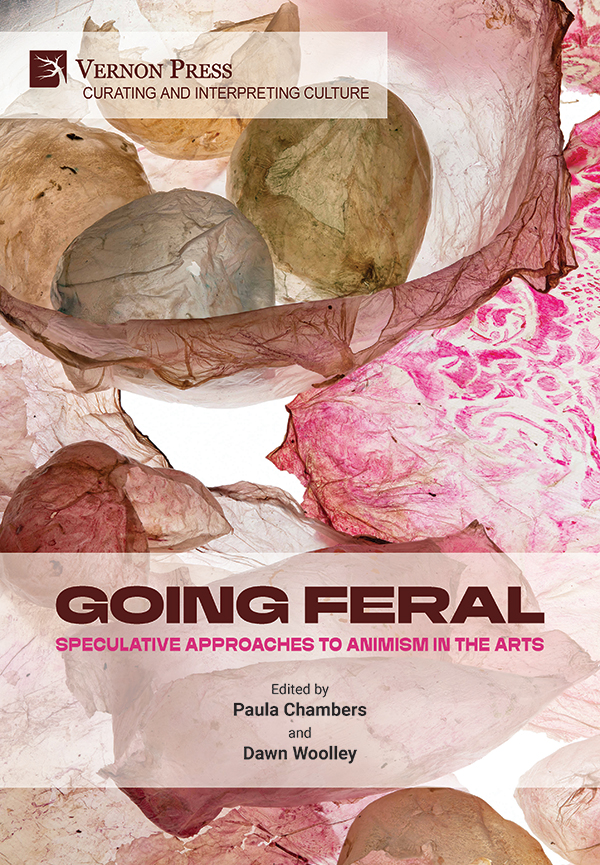
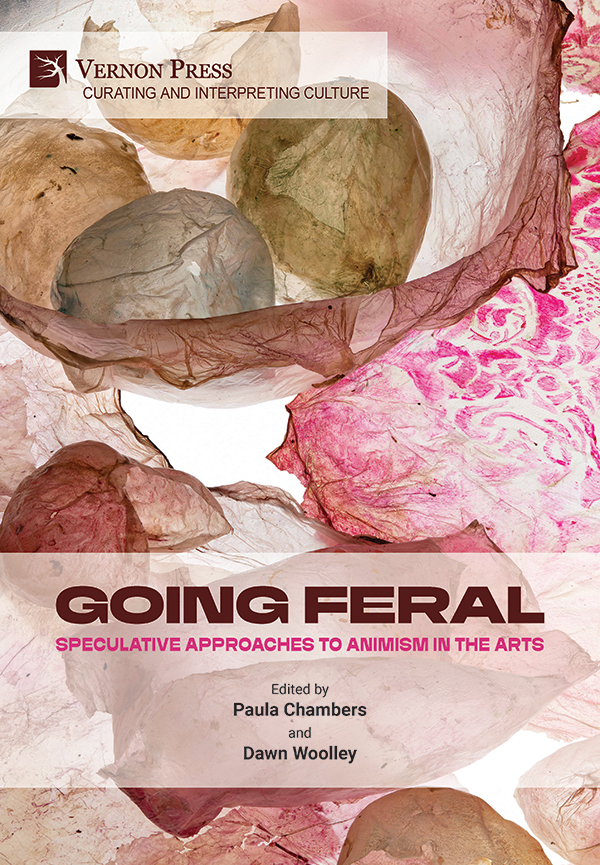
Going Feral: Speculative Approaches to Animism in the Arts
Dawn Woolley, Paula Chambers (Eds.)
by Paula Burleigh (Allegheny College, Pennsylvania), Paula Chambers (Leeds Arts University), Angela Tait (University of Salford), Sandrine Welte (Ca‘ Foscari University of Venice, Italy), Solomon Burge (Somerset House Trust), Adel Sliti (Manouba University,Tunisia), Marianna Tsionki (Leeds Arts University), Mariana Cabello (ITESM - Tecnológico de Monterrey, Mexico), Gudrun Filipska (Lancaster University), Luciana da Costa Dias (Institute of the Arts, University of Brasilia, Brazil), Margaryta Golovchenko (University of Oregon), Laura Bissell (Royal Conservatoire of Scotland), Lize van Robbroeck (Stellenbosch University)
Purchase this book
(click here to change currency)
This is an important book that adopts speculative methodologies to consider what it might mean to give agency to materials and non-human co-producers of the world in which we live using a wide range of artworks and artmaking as its scoping tools. Speculation is taken up as a feral act in its capacity to resist boundaries of the known and the historically located. Thus, the essays brought together operate and create space between wild and domestic living, crossing back and forth, contaminating one another and their materials. The essays hover between materialism, animism and post-colonial discourses, disrupting and infecting, drawing attention to state of anxiety and increasing inequalities that have become the characteristics of late-capitalist society. The authors collectively offer new ways to think of what it means to be in community with the world as a whole, offering optimistic approaches that are both realisable and realistic. “Going Feral” is speculative, and it is agential – this volume gives hope and ambition.
Prof. Dr. Catherine Dormor
Textile Practices & Feminisms
University of Westminster
This book responds to the unimagined consequences of imperial, colonial and industrial infrastructures through the boundary art practices of going feral. Grounded in animism and attentive to its cultural and political complexities, it speculates on how to untame and disrupt the European project of expansion. An invaluable multidirectional guide for readers interested in more-than-human entanglements and the potential futures they materialise.
Dr. Basia Sliwinska
Researcher
Art History Institute (IHA), Universidade Nova de Lisboa, Portugal
“Going feral: Speculative approaches to animism in the arts" provides an impactful art theoretical framework with key case studies to further the important intellectual work of debunking dualistic, anthropocentric thinking and carving space for pluralistic understandings of our post-humanist existence. Through the biological and intellectual concepts of ferality and animism, the co-editors produce a nuanced, yet radical framework that pushes past binary-based thinking and brings contemporary conceptualization, including feminist thought, queer theory, post-humanism and performance, into new territories. Through key essays that engage boundary-pushing art and conceptual practices, important voices in the materialist, decolonial and resistance movements of international scope are brought together into one volume. The cross-disciplinary scope of this text, while grounded in contemporary art practices and research, provides imaginative and speculative methodologies to foster meaningful relationships in our precarious and uncharted future through criticality, care and consideration.
Prof. Diana Heise
Kansas City Art Institute
This edited volume presents critical analyses of animism in the arts with a focus on the boundary practices of going feral. Reconsidering the question posed by Cecilia Alemani, Venice Biennale 2022 curator, authors explore ‘what would life look like without us?’, in a world activated by things and a post-humanist animism. These speculative discussions are developed in this volume, in which we consider how the process and practices of going feral might materialise through and across creative investigations.
Going feral is a provocative call to untame, queer and radicalize feminist thought and practice, producing more-than-human, multispecies entanglements, and processes of dynamic resistance. The chapters critically analyse processes of going feral in artworks and art practices ranging from fine art, art history and performance to architecture, video games and poetry. They consider how going feral allows audiences to form meaningful relationships with spoiled landscapes, develop human and non-human communities, and to reimagine the domestic and the everyday through the prism of new animism. The creative practices discussed are geographically diverse, including examples from South Africa, Brazil, Ukraine, South Korea, Mexico, the Caribbean, Europe and North America. Through these wide-ranging approaches and case studies, the book asks, what are potential futures materialised through artworks that rethink the present as a world populated by things, a place where the sensibility of materials becomes carriers of agency?
This edited volume argues that animism and ferality are vital tools for artists and creative professionals to describe and critique the increasing inequalities and continuous states of emergency that characterise late-stage capitalism. The concept of going feral is a critical framework to frame contemporary issues such as environmentalism, waste and discard studies, and speculate ways of decentring anthropomorphism.
List of Figures
Foreword
Professor Graham Harvey
Emeritus Professor at Open University
Chapter One
Boundaries, Borders and Peripheries: In the Gap Between ‘Wild’ and ‘Domestic’
Paula Chambers
Leeds Arts University
Dawn Woolley
Leeds Arts University
MATERIAL AGENCY
Chapter Two
Holders of Soup and Meaning: Clay as Feral Material
Angela Tait
University of Salford
Chapter Three
Seres Montañas: An Animist Speculation on Entangled Houses
Mariana Cabello
ITESM - Tecnológico de Monterrey
Chapter Four
Acting Matter: Installing Propositions for Alternative Ontologies in the Arts
Sandrine Welte
Ca‘ Foscari University of Venice, Italy
Chapter Five
Sadong 30: The Animistic Domestic in the Work of Heague Yang
Paula Chambers
Leeds Arts University
POST-HUMANIST PERSPECTIVES
Chapter Six
Against Human Exceptionalism: Plants in Contemporary Art
Paula Burleigh
Allegheny College, Pennsylvania
Chapter Seven
Le Rêver: A Hidden Feral-ity in the Fragility of Digital Landscape
Solomon Burge
Somerset House Trust
Chapter Eight
Feral Mobilities and the Particulate Feral
Gudrun Filipska
Lancaster University
Chapter Nine
Performing Feral Maternal(s)
Laura Bissell
Royal Conservatoire of Scotland
COLONIAL HISTORIES
Chapter Ten
Spirits, Liquid Bodies, and More-Than-Human Entities in Indigenous Cosmologies
Marianna Tsionki
Leeds Arts University
Chapter Eleven
“The first god was a gommier”: Of God Trees and ‘ancestrees’ in Derek Walcott’s Poetics
Adel Sliti
Manouba University, Tunisia
Chapter Twelve
Domesticated Beasts as Decorative Objects in Gustave Leonard de Jonghe’s Woman at the Piano with Cockatoo (c. 1870)
Margaryta Golovchenko
University of Oregon
Chapter Thirteen
The River Tells: Contemporary Indigenous Art from Brazil and the Limits of Human Exceptionalism
Luciana da Costa Dias
Institute of Arts, University of Brasilia (IdA/UnB)
Chapter Fourteen
A Hauntology of Colonial and Settler Domesticity: The Material Semiotics of Leora Farber’s Still Life Installation, Disquieting Domesticities/Vestiges of Violence
Lize van Robbroeck
Emeritus Professor at Stellenbosch University
About the Contributors
Index
Paula Chambers is an artist, academic and arts educator. She studied with Professor Griselda Pollock at the University of Leeds on the MA Feminist Art History, Theory, Criticism and Practice in the Visual Arts (MAFEM, 1993) and completed her PhD by practice at Middlesex University in 2020. Her research explores the agentic potential of feral objects in their role as sculpture. Specifically, how the disruption of the objects and materials of feminine material culture as feminist art practice, as they perform as sculpture, troubles the historical, social and culture understanding of women’s relationship to domesticity.
Dawn Woolley is an artist and research fellow at Leeds Arts University. She completed an MA in Photography (2008) and a PhD by project in Fine Art (2017) at the Royal College of Art. Woolley’s research examines contemporary consumerism and the commodified construction of gendered bodies, paying particular attention to the new mechanisms of interaction afforded by social networking sites. Recent publications include: “#Rebel Selves: queer selfies as practices of care”, 'Photographies, 2025 and Consuming the Body: Capitalism, Social Media and Commodification,' London: Bloomsbury 2025.
post-humanism, ecology, performance, non-binary, animism, post-colonialism, vegetal turn, art history
Subjects
Sociology
Interdisciplinary
Series
Curating and Interpreting Culture
Related services
Find in a library near you Download HQ cover Find in Bookshop.orgBibliographic Information
Book Title
Going Feral: Speculative Approaches to Animism in the Arts
ISBN
979-8-8819-0406-7
Edition
1st
Number of pages
286
Physical size
236mm x 160mm