Loading...
Please wait while we load the content...

Loading...
Please wait while we load the content...
University of Minho, Portugal

By: Arthur Schwaninger, Dina Mendonça, João Fonseca, Jona Förster, José M. Araya, Mark Miller, Matthew Sims, Miguel Pais-Vieira, Nicolás Lori, Jarno Tuominen, Susanne Uusitalo, Valtteri Arstila, Wanja Wiese, Jelena Markovic, Manuel Curado, Jorge Gonçalves, and Thomas Metzinger
The Predictive Processing Theory of Mind is a recent theory developed by philosophers, cognitive scientists, and neuroscientists about the nature and function of the brain and its role in creating the conscious mind that we humans, and perhaps some non-human animals, have. The authors that advanced those lines of research believe that there is a fundamental idea that has been overlooked in the research done about the brain until the present: that the brain is a prediction machine with the function of creating hypotheses about the causes of our sensory signals and predictions of possible future sensory signals. Moreover, the internal models of the world created this way are constantly challenged by incorporating the errors of the previous models into new models. From this point of view, the brain's work could be described as a process of making predictions about the upcoming sensory data based on its best current models of the causes of those data. This book intends to critically analyze this theory and its subsequent theoretical and empirical consequences. To achieve that, the volume brings together some of the best experts on Predictive Processing – such as Thomas Metzinger, Wanja Wiese, or Mark Miller – with the goal of presenting some of the advantages of this approach but also some of its caveats.
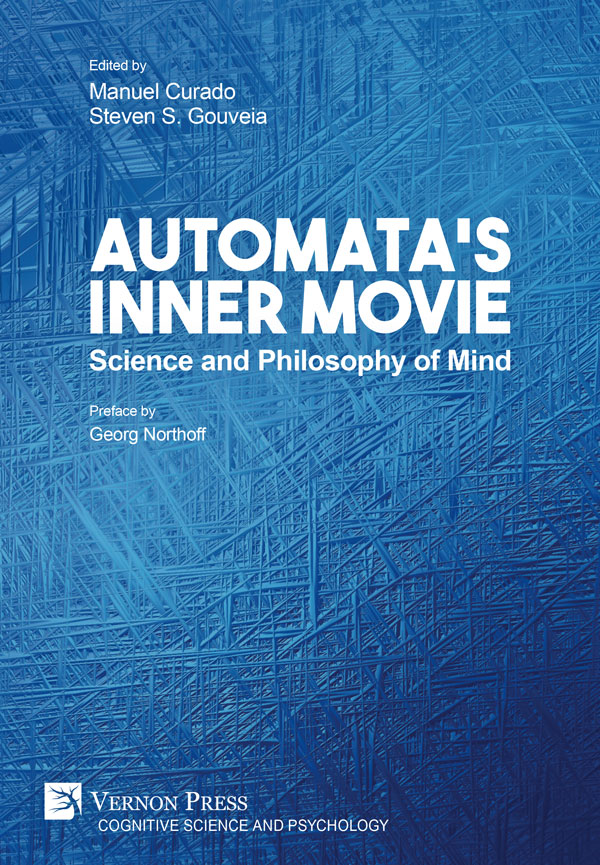
By: Manuel Curado, Igor F. Mikhailov, Manuel Cebral, Liat Lavi, Andrea Roselli, Alexander Lazarov, Paulo Vieira, Judite Zamith-Cruz, Hugo Neri, Veridiana D. Cordeiro, Maiya Jordan, Eros Moreira de Carvalho, Paulo Jesus, Sami Nenno, Steven S. Gouveia, Hortense de Villaine, Ivan V. Ivanov, Zong Ning, Federico Zilio, Nathália Pantaleão, Nicolás F. Lori, Emilia Samit, and German Picciochi
This book brings together researchers from a variety of fields to jointly present and discuss some of the most relevant problems around the conscious mind. This academic plurality perfectly characterizes the complexity with which a current researcher is confronted to discuss and work on this topic. The volume is organized as follows: Part I introduces the general problems of Philosophy of Mind and some historical perspectives. Part II focuses on understanding the input that the empirical sciences can offer to the theoretical problems. Part III discusses some of the core concepts of the field, namely, perception, memory and experience. Part IV debates human and artificial intelligence and, finally, Part V deliberates about the computation and the ethics of big data and artificial intelligence. The book contains valuable material for researchers in several fields such as Cognitive Science and Neuroscience, Psychology and Artificial Intelligence, and Philosophy. It can also be used as a guide to some courses at various levels, from BAs to MAs and PhD courses of several fields. It is our belief, as it is claimed in the preface by Georg Northoff, that there is an urgent need for a truly transdisciplinary exchange between philosophy and the sciences in order to stimulate some real progress. We hope that this book will become a sound step for such an interdisciplinary enterprise.